
The CETA URN: how one email decides your duty rate on UK imports
CETA preference on UK imports turns on one email to a CBIC mailbox. Here is the URN flow, the ten rejections, and the brief for your supplier.
- India-UK CETA
- Imports
- Rules of Origin
- Compliance
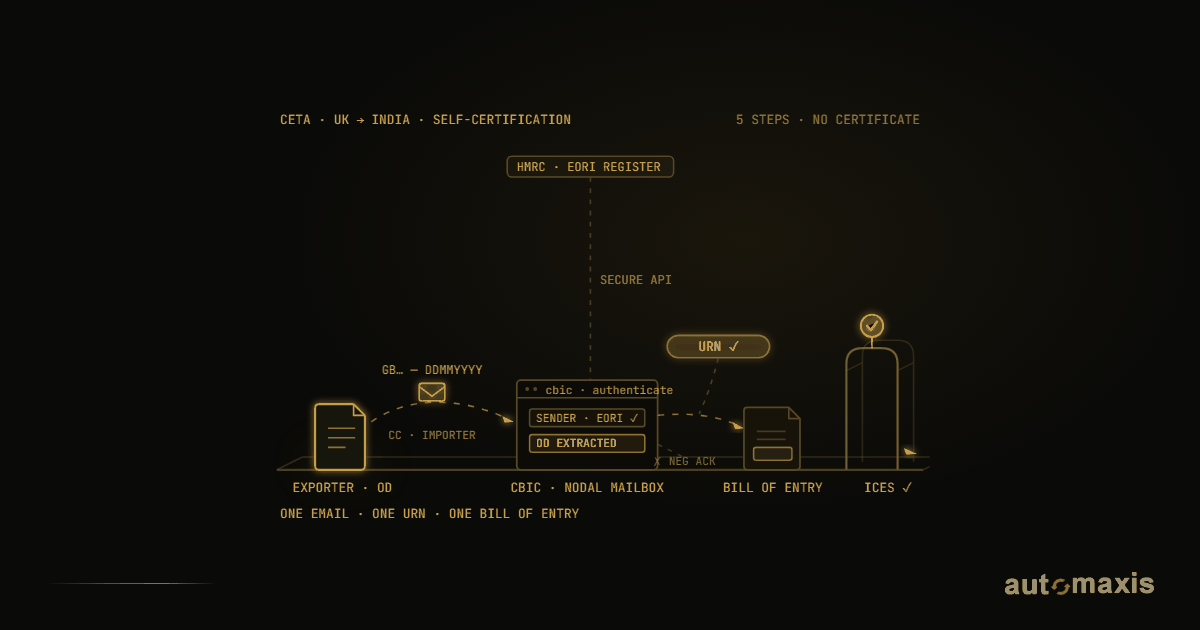
To claim the reduced rate of duty on UK goods under the India-UK CETA, your Bill of Entry must quote a Unique Reference Number (URN), the reference Indian Customs issues once it has authenticated your UK supplier's origin declaration. And the URN is issued from the strangest place in Indian customs right now: an email inbox. Your UK supplier emails their origin declaration to a designated CBIC mailbox, an automated system checks the sender against a database the UK has shared with India, and if everything lines up, a reply lands carrying the URN. No portal, no counter, no stamp. One email.
The machine is precise, and it rejects for small things: a second attachment, a misformatted subject line, a sender address nobody registered. CETA entered into force on 15 July 2026. The rules of origin come from Notification 62/2026-Customs (N.T.), the self-certification framework from CBIC Circular 33/2026-Customs, and ICEGATE, the customs portal, published a trade advisory on 13 July setting out the process end to end. This post turns that advisory into a working procedure: the five steps, the exact email spec, the ten rejection scenarios, and the brief to send your UK supplier today.
The Origin Declaration: the document that starts it all
An Origin Declaration (OD) is the only proof of origin that works for imports from the UK under CETA. It is self-certified: your UK exporter or producer completes and signs it themselves, on the prescribed template (Annexure-B of the origin rules, Annex 3B of the agreement). No chamber of commerce, no issuing authority, and a certificate of origin from either will not work. Why the law is built that way, and the due-diligence burden it leaves on you, is covered in our CAROTAR post; this one is about getting the URN issued and onto the Bill of Entry without a rejection. One corridor note for those trading beyond the UK: the India–NZ FTA, in force since 20 October 2026, runs its proof the other way — a certificate from a designated issuing authority is the working route, with origin declarations gated behind an authentication exchange that is not yet live. That contrast is unpacked in the India–NZ origin guide.
What the OD carries: the signatory and their details, the exporter's EORI (the UK's customs registration number for businesses), your details including your ICEGATE-registered email address, and one row per product with the 6-digit HS code, description, invoice number and the origin criterion claimed. The criterion is a three-letter vocabulary: WO for goods wholly obtained within the parties, PE for goods produced exclusively from originating materials, PSR for goods that meet the product-specific rule for their HS code, with the rule itself cited on the form.
One OD covers one shipment. And on its own it earns nothing. Preference is granted only after the OD has been authenticated by Indian Customs, which is what the email machine is for.
Getting the URN: the five steps, start to finish
Step 1: the UK shares its exporter register. HMRC, the UK's tax and customs authority, transmits master data on registered UK exporters, their EORI numbers and the email addresses registered against them, to Indian Customs over a secure API. This standing exchange is what lets a machine in Delhi decide whether an email from Manchester is genuine.
Step 2: your supplier sends the email. The completed OD goes as a single PDF to CBIC's nodal address, cbic.customs.indiaukceta@CBICIndia.onmicrosoft.com, with you in copy, sent from the email address registered against their EORI.
Step 3: the system authenticates. CBIC's automated system validates the sender against the HMRC data, checks the subject line and the attachment, and extracts the OD's contents.
Step 4: the acknowledgement arrives. A positive acknowledgement, carrying the URN, goes to both your supplier and you. A failed authentication draws a negative acknowledgement stating the reason.
Step 5: you file. You quote the URN in the Bill of Entry to claim the preferential rate, and ICES (the customs EDI system) validates the URN before granting it.
Keep one distinction in view: the URN authenticates the sender, not the goods. Customs can still question whether the goods actually originate in the UK, and that question lands on you. The full shape of that burden lives in the CAROTAR post.
The email spec, exactly
Most rejections in this system are email-formation failures, so the spec deserves a table you can forward verbatim.
| Field | Requirement |
|---|---|
| To | cbic.customs.indiaukceta@CBICIndia.onmicrosoft.com |
| Copy | You, at your ICEGATE-registered email address |
| From | The address registered against the exporter's EORI with HMRC |
| Subject | The exporter's EORI, then the OD's date as DDMMYYYY, reproduced exactly as the advisory prints it: GB123456789000 — 15072026 |
| Attachment | The OD alone: one PDF, no invoice, no packing list, nothing merged in |
| Layout | A4, portrait orientation only |
Two details in that table sink real shipments. The date in the subject line must match the date on the OD; if the subject is malformed, the negative acknowledgement comes back quoting the correct format to use. And the attachment rule is absolute: a supplier who helpfully merges the invoice into the same PDF, or attaches commercial documents alongside, gets rejected, because the system processes a standalone OD and nothing else.
Where the same exporter sends you several ODs on the same day for goods under the same tariff classification, make sure a separate URN has arrived for each OD before you file.
One declaration, one Bill of Entry
Each OD can be used once. All goods it covers go into a single Bill of Entry (BoE), and an OD cannot be split across several. A URN used in one Bill of Entry cannot be quoted in another: the same rule again, with one exception for warehoused goods covered below.
The OD is valid for twelve months from the date it is completed, and the Bill of Entry for home consumption must be filed within that window. Timing runs the other way too: the URN must exist before you file. Have the OD sent as soon as the goods ship, not when they reach the port.
The ten rejections, and their fixes
The advisory lists every circumstance in which authentication fails. All ten are worth sharing with your supplier before their first shipment, because every one of them stalls your clearance, not theirs.
| Sr. No. | What went wrong | The fix |
|---|---|---|
| 1 | No attachment in the email | Resend with the OD attached as a single PDF |
| 2 | Attachment could not be read | Check the PDF opens, follows the prescribed template, and contains only the OD |
| 3 | Attachment is not a PDF | Convert to PDF and resend as a single attachment |
| 4 | Attachment is empty or zero size | Verify the file before sending; reattach and resend |
| 5 | More than one attachment | Remove everything except the OD PDF and resend |
| 6 | EORI not found in the database | The exporter is not registered with HMRC for UK-India CETA origin declarations, or the EORI is mistyped; register or correct, then resubmit |
| 7 | Sender email not registered against the EORI | Update the registered address with HMRC, or resend from the address that is registered |
| 8 | Subject line incorrect or missing | Resend with the prescribed format; the subject-line date must match the OD's date |
| 9 | Mandatory fields missing from the OD | Ensure the EORI, origin criterion, 6-digit HS code and your email are present and legible; resubmit |
| 10 | Duplicate OD | If it is genuinely a new shipment, correct the details that make it distinct; if it is an amendment, use the MODIFY route below |
In every case the negative acknowledgement goes to your supplier with the reason spelled out. Chase it the day it arrives. None of these fix themselves.
Corrections close at clearance: the MODIFY route
An OD can be corrected after its URN is issued, right up to Out-of-Charge (the final customs release of the goods) and not a minute after. The exporter sends the corrected OD as a fresh email with the subject line <Original URN> - MODIFY, and what happens next depends on how far your import has travelled:
- Before your Bill of Entry is filed: the original OD is cancelled and a new URN is issued. File with the new one.
- After filing, before Out-of-Charge: a new URN is issued and the original stays on record, but the system ensures the benefit is claimed only once. If the original URN already carried a claim, the new one cannot be used for the same purpose again.
- After Out-of-Charge: the modification is rejected. The certificate is fully consumed; the original OD and URN stand final. For warehoused goods, the clock runs to the Out-of-Charge on the ex-bond Bill of Entry.
The window for corrections, in other words, closes with clearance. Reconcile the OD against the invoice before you file, not after.
Warehoused goods: the one exception
CETA's transitional rule reaches goods that were already in India when the agreement came into force, and the URN mechanics follow them into the warehouse:
- Bonded before 15 July 2026: no URN could have been quoted on the warehousing Bill of Entry, because the agreement was not yet in force when it was filed. The supplier issues the OD now, dated on or after 15 July, including the invoice number so the declaration ties back to that warehousing Bill of Entry. The URN then goes on the ex-bond Bill of Entry through which you claim preference.
- Bonded on or after 15 July 2026: the URN is obtained first and declared on the warehousing Bill of Entry itself, then quoted again on the ex-bond filings.
- Clearing in lots: one warehousing Bill of Entry can feed several ex-bond Bills of Entry on the same URN. This is the single exception to one-URN-one-BoE, and each ex-bond filing must still land within the OD's twelve-month validity.
- Sold while in bond: the URN transfers with the goods; you quote it for the quantity you keep, buyers quote it on theirs, and once the last lot is ex-bonded the OD is fully consumed.
The brief to send your UK supplier
Everything above compresses into eight lines. Send them before the first shipment, not after the first rejection.
- Register your EORI and your sending email address with HMRC for UK-India CETA origin declarations.
- Use the prescribed CETA Origin Declaration template, A4 portrait, every mandatory field completed: your EORI, the origin criterion per product, 6-digit HS codes, and our email address.
- Our ICEGATE-registered email is: (fill this in, and keep it current on ICEGATE).
- Email the OD to cbic.customs.indiaukceta@CBICIndia.onmicrosoft.com with us in copy, from your HMRC-registered address.
- Subject line: your EORI, then the OD's date as DDMMYYYY, exactly in the prescribed format, matching the advisory's example.
- Attach the OD alone. One PDF. No invoices or other documents, attached or merged.
- One OD per shipment, and a separate OD (and URN) for each same-day consignment.
- Forward us every acknowledgement, positive or negative, the day it arrives.
Where automation earns its keep
Every check in this post happens before a Bill of Entry, against an email thread and a PDF that someone else controls. FDP Connect's importer module holds the OD against its URN and its twelve-month clock, validates the declaration against the email spec before your supplier sends it, enforces one-OD-one-BoE so a used URN never reaches a second filing, and tracks warehouse URNs across ex-bond clearances so a lot cleared in March does not orphan the one you clear in August.
If you want the legal frame under all this (Section 28DA, Form I, the five-year record obligation), read the CAROTAR post. If you are on the other side of the corridor and exporting to the UK, our CETA explainer covers the tariff picture and the exporter's route.
For Bill of Entry and claim questions, the advisory points you to the systemic Customs officer or Appraising Officer at your port of import; for ICEGATE registration and email updates, use icegate.gov.in, the 24x7 helpdesk on 1800-3010-1000, or icegatehelpdesk@icegate.gov.in.
Reflects the ICEGATE advisory of 13 July 2026 on CETA origin authentication, CBIC Circular 33/2026-Customs of 13 July 2026 and Notification 62/2026-Customs (N.T.) of 3 July 2026, as at 22 July 2026. The corridor is a week old and CBIC procedure around it is still settling. Verify against the current CBIC position before you file.