
CAROTAR and India-UK CETA: what importers must prove
Claiming CETA preference on UK imports puts you inside CAROTAR 2020. Only one form of proof works into India, and it is not a certificate of origin.
- CAROTAR
- India-UK CETA
- Imports
- Rules of Origin
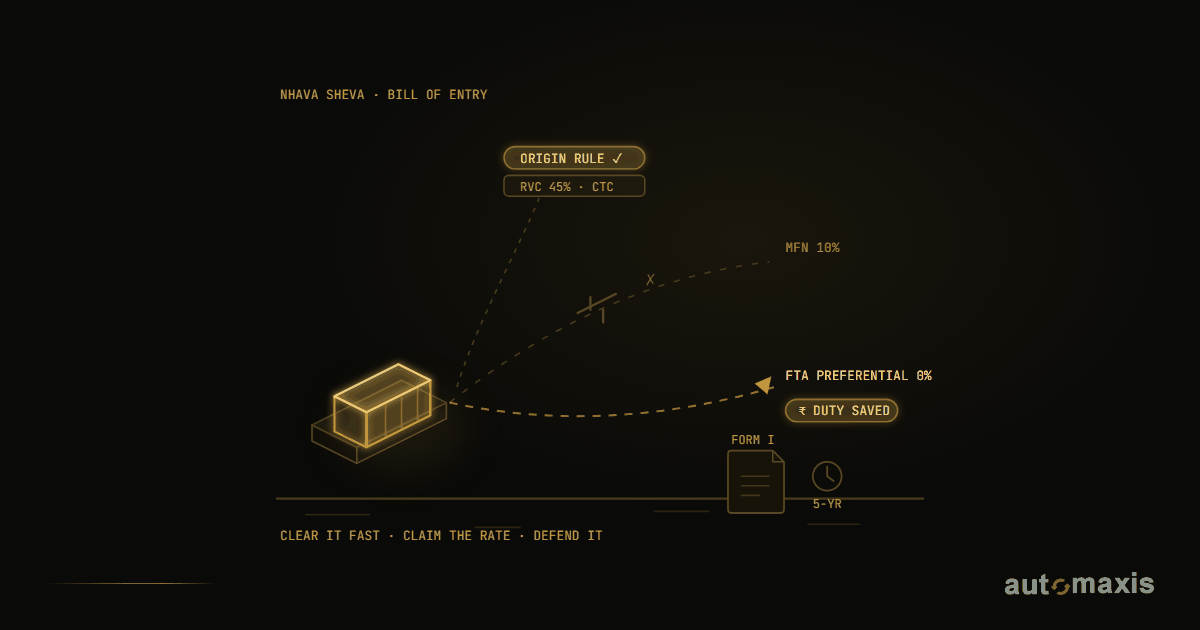
Short answer: yes. If you are importing goods from the United Kingdom and claiming the preferential rate of duty under the India-UK CETA, you are inside CAROTAR 2020, and the obligations are yours, not your supplier's.
The trigger is worth being precise about, because it is the thing people get backwards. CAROTAR bites on the claim, not on the origin. Import UK goods and pay the ordinary MFN rate and CAROTAR never enters the picture. Claim one rupee of CETA preference and the whole framework attaches: due diligence, minimum origin information, five years of records, and personal exposure if the claim turns out to be wrong.
CETA entered into force on 15 July 2026. What follows is what actually changes for an importer on the India side.
The rule that surprises everyone: only one proof works
Most importers assume a preferential claim means collecting a Certificate of Origin from the supplier, the way it works under most of India's other agreements. Under CETA, importing into India, a certificate of origin is worthless.
The proof-of-origin rules are asymmetric, and this is the single most important fact on this page:
| Direction | What counts as proof of origin |
|---|---|
| India to UK (you are exporting) | An origin declaration by the exporter or producer, or a certificate of origin from an Indian issuing authority, or importer's knowledge |
| UK to India (you are importing) | Only an origin declaration completed by the UK exporter or producer |
Read the second row again. No third-party certificate. No chamber of commerce. No importer's knowledge, which several modern FTAs allow and CETA allows in the other direction. If your UK supplier sends you a certificate of origin from some issuing body, you do not have a valid proof for an Indian preferential claim, however official the document looks.
This is also why the law had to change. A regime built around a certificate signed by an issuing authority cannot accommodate a document the exporter writes about itself. So the Finance (No. 2) Act, 2024 amended Section 28DA of the Customs Act 1962 to speak of a "proof of origin" rather than a "certificate of origin", widening the definition to include a declaration and the issuing party to include a person, not just an authority. CAROTAR 2020 was then aligned to match by Notification 14/2025-Customs (N.T.), with CBIC Circular 14/2025 confirming the shift toward self-certification. The obligation did not soften. It just stopped assuming a third party had checked anything first.
Which is the real shift here, and it is worth sitting with. Under a certificate regime, somebody with a stamp looked at the claim before you did. Under CETA into India, nobody has. The document you are relying on was written by the party who benefits from it, and the due-diligence burden that a certificate used to partly absorb now sits entirely on you.
The authentication ritual, and the URN you need
CETA does not just accept any self-written declaration. There is a prescribed authentication route, and it is unusually mechanical.
Your UK supplier registers their EORI and their sending email addresses with HMRC, once. Then, per shipment, they complete the prescribed CETA origin-declaration template (a CETA-specific layout, not the generic UK free-trade-agreement statement text), in English, and email it as a single PDF to CBIC's nodal address, with you in copy. The subject line has to be exactly their EORI followed by the declaration's date as DDMMYYYY, in the format CBIC prescribes.
CBIC auto-responds with a Unique Reference Number (URN); the declaration behind it is valid for twelve months from its date. You quote that URN on your Bill of Entry when you claim preference.
CBIC's system auto-rejects on format alone: wrong subject line, a non-PDF attachment, more than one attachment, a sender email that is not registered, missing importer details. None of those failures are about whether the goods actually originate in the UK. They are about whether the email was formed correctly, and they land on your claim, not your supplier's. The exact email spec, all ten rejection scenarios and the correction route are in our URN walkthrough.
And here is the part worth reading twice, because it is easy to mistake a URN for a clean bill of health. Authentication is not verification. CBIC's confirmation establishes that the declaration came from a genuine, registered UK exporter. It says nothing whatsoever about whether the goods actually originate in the UK. The URN authenticates the sender, not the claim. Nobody has checked the substance, and the party who has to defend it later is you.
One declaration covers one shipment. There is no blanket or period declaration for imports into India.
The dating trap
CETA's transitional rule lets goods already on the water or sitting in customs storage on 15 July 2026 claim preference. But the origin declaration must be dated 15 July 2026 or later. A declaration dated earlier is rejectable, even for those in-transit goods, because on the date it was written the agreement it references did not yet exist.
If you have UK shipments landing now against paperwork your supplier prepared enthusiastically in June, check the dates before you file.
What CAROTAR actually requires of you
Not possession of a document. Possession of information, plus a defensible basis for believing it. Section 28DA requires the importer to hold the minimum origin information (the Form I data set) and to exercise reasonable care. "My supplier said so" is not reasonable care; under CETA it is close to circular, since the supplier is the only author of the proof.
What you need on file, per line:
- The proof of origin, in the form CETA accepts. For UK imports, the exporter's origin declaration, with its URN, within validity, matching the consignment.
- The origin criterion claimed, per product: wholly obtained, produced entirely from originating materials, or satisfying the product-specific rule. Recorded, and matching CETA's own annex for that HS code, not a criterion carried over from a different agreement.
- The evidence behind the criterion. Where a qualifying-value-content rule is claimed, the QVC percentage and whether it was computed build-up or build-down, on an ex-works or FOB base. Where a tariff-shift rule is claimed, the input HS codes against the product HS code showing the shift actually occurs.
- Cumulation or tolerance, if relied on. CETA's de minimis is banded, not a single number: 7.5% for some chapters, 12.5% for others, on a value or net-weight basis depending on the rule. Using the wrong band is a silent failure.
- Direct consignment. Transit or splitting through a non-party is allowed only under customs control with no processing beyond unloading, reloading, preservation or splitting. Keep the evidence.
- The supporting set: invoice, packing list, transport document, and the bill of materials or cost sheet where value content is claimed.
Then keep all of it. CETA says four years. CAROTAR says five. Keep it five. The stricter obligation is the one that binds you.
What happens when the claim is questioned
Customs can ask, and the process escalates: written information requests, questionnaires, records, and ultimately verification visits to the exporter's premises. Selection is risk-based, random or intelligence-led. Repeated verification failures or suspected deliberate breach can lead to preference being suspended for that exporter altogether.
While a query is open, your goods do not simply wait. Preference gets denied or the assessment goes provisional against security, which means cash or bond posted on the differential, on your working capital, until it resolves.
Two provisions worth knowing because they cut in your favour:
- Minor errors cannot sink a proof on their own. Typos and format slips are curable, and you get 30 days to fix an illegible or defective proof.
- A late claim is possible. CETA lets you claim preference up to one year after importation and recover the excess duty. Useful if a shipment clears at MFN before the declaration arrives. It is a recovery route, not a filing strategy.
And one that cuts against you: if you learn your claim was wrong, you have an affirmative duty to correct the documents, tell customs and pay the duty. Discovering an error and sitting on it is a different and worse problem than making it.
Where automation earns its keep
Every failure mode above is a check that has to happen before the Bill of Entry, on a document written by someone else, in a corridor that is a day old.
The checks are mechanical, which is exactly why people skip them: is the proof an origin declaration and not a certificate somebody helpfully sent instead? Is the URN present, and does the EORI and date on the declaration match the URN record? Is the declaration dated on or after 15 July 2026? Is the criterion on file the one CETA's annex actually specifies for that HS code? Is the de minimis band the right one for that chapter?
FDP Connect's importer module runs those as gates rather than reminders: it validates the proof form against the agreement being claimed, holds the URN against the declaration, keeps the Form I data set per line with its five-year clock, and sweeps cleared Bills of Entry from the last twelve months for preference you were entitled to and never claimed.
If you are on the other side of this and exporting to the UK, our CETA post covers what you have to prove to make a claim stick, where the rules are more forgiving in your favour. For the underlying distinction between preferential and non-preferential origin, start here.
Reflects Section 28DA of the Customs Act 1962 as amended by the Finance (No. 2) Act, 2024, CAROTAR 2020 (as amended by Notification 14/2025-Customs N.T.), CBIC Circular 14/2025, and the India-UK CETA rules of origin, as at 16 July 2026. CETA is a day old and CBIC procedure around it is still settling. Verify against the current CBIC position before you file.